

2025 NEW DRYAD DAFFODILS
These will only be available on EBAY this year, where I can spare some.
ALBIORIX

ALBIORIX 10 W-W
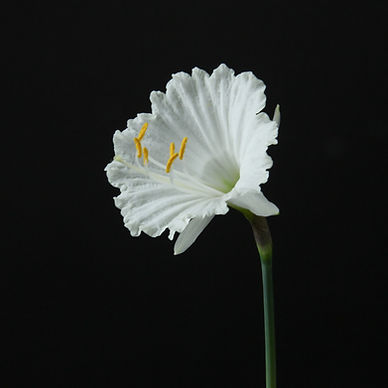
This stunning hoop petticoat won me my AGS Farrer Medal at Wisley this year - finally after 40 years of showing! Bred from N. romieuxii × N. cantabricus var. petunioides, it has fragrant, icy-white, upward facing flowers on short stems. The corona is widely conical, with the rim finely toothed, and the style and stamens well exserted. The narrow, erect leaves rise above, but never detract from the flowers.

ANNE BLANCHARD
ANNE BLANCHARD 5 W-W
Bred from N. triandrus × Div 6 small white unregistered seedling
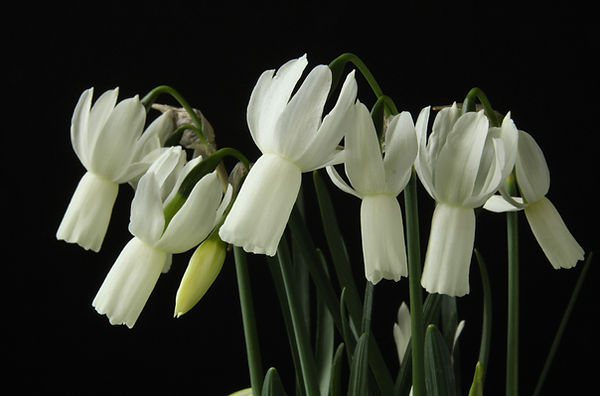
At last, I’ve given in and named one after myself, Blanchard being my maiden name. I bred this one aiming for a white version of ‘Andy Blanchard’, named after my late brother. Whereas Andy Blanchard is creamy lemon, Anne Blanchard is ivory white, with the perianth not as severely swept back, but sweeping back more gracefully (those who know me are allowed to laugh at this point). Flowering at 12 cm high, there are 1-2 flowers per stem. I’m happy that Andy and myself now make a unique pair of daffs! I need to bulk this up another year before I can offer any.


BABY GANNET


BABY GANNET 6 W-W/Y
Bred From Snipe x Candlepower, Baby Gannet is named for similarity of the colouring of the corona to that of a gannet, grading gradually from lemon at the mouth to white at the base. The perianth is gracefully reflexed, overlapping at the base, while the corona flares gently to a frill at the mouth. Flowering at only 14cm high, it is small enough for miniature classes, and as a bonus, has a light, fresh scent.


BEE FLY


BEE FLY 5 Y-Y
A distinctive reverse bicolour triandrus x scaberulus hybrid, Bee Fly is named after one of my favourite insects (although with a rather unsavoury habit), like a fluffy little hummingbird hovering in front of flowers before darting in to sip the nectar. The neat little flowers, 2-3 per stem, seem to hover above the upright stems, the effect amplified by the semi-prostrate leaves. The cup is pale, creamy yellow, while the swept back perianth is bright lemon. It is sweetly scented, presenting the flowers to your nose on 19cm stems!

BLUSH BABY


BLUSH BABY 1 W-Y/O
Blush Baby will never win a daffodil show, with her wildly frilled trumpet and wayward perianth, but I have named this little treasure because her delightful peachy pink corona and tiny stature may hopefully lead to some interesting new miniature seedlings. Bred from award-winning Keira hybrid KB-M-1-2007 x asturiensis, she tips a nod of gratitude to Graham Fleming’s generosity in sharing his breeding work with beginners on this side of the planet. Hopefully Blush Baby can do the same.

DAMSELFLY

DAMSELFLY 5 Y-Y
Bred from N. triandrus subsp. triandrus × N. cordubensis pale form.
Although in my favourite pastel lemon shade, Damselfly is named after the little creatures flitting about my pond in brilliant colours in the warm weather. Like Bee Fly, the long reflexed perianth, and shorter cup on 20cm stems, give the impression that the flowers are taking flight. The leaves are erect but well below the flowers, so don’t spoil the effect. With up to four flowers per stem, just a few bulbs can give an impressive display. This lovely cultivar was a favourite in the nursery this year.


FALCO

FALCO 5 W-W
Bred from N. triandrus subsp. triandrus × N. cantabricus subsp. cantabricus var. petunioides
A very distinctive member of our new triandrus x bulbocodium section cultivar group, characterised by the long tube flushed yellow at the base and visible above the nodding white flowers. Flowering at 15cm high, the 52mm spread of the perianth tips it out of the miniature classes, but makes a stunning pot for an alpine exhibitor. The perianth is slightly reflexed and the cylindrical corona is fluted. Prostrate leaves and a light perfume completes the picture.


HALIMEDE


Our second hoop this year is from Columba x Tethys, and like Albiorix, flowers on short stems, but the wide-open flowers are pale lemon, more gently crenate at the rim, with the longer perianth peeking out from behind the corona.
These two new hoop petticoats both flower very early in February - they need growing under glass so they can have a dry rest in summer, and will be stunning in your glasshouse during the dullest season in the garden.
ICE CROWN

ICE CROWN 12 W-W
Bred from N. triandrus subsp. triandrus × N. cantabricus subsp. cantabricus var. petunioides and sister to Falco, Ice Crown has been placed in division 12, since it shows its cantabricus parentage more strongly, and the crown-like perianth is not reflexed. Flowering at 13cm high over prostrate leaves, the strong stems each carry 1-2 flowers of pure white, the conical corona prettily fluted and richly scented.
Like Falco, it is just a little too wide in the perianth to be eligible for miniature classes, but makes a wonderful pot subject for an alpine exhibitor.


LITTLE ENGLAND


LITTLE ENGLAND 6 Y-Y
Bred from ‘Englander’ × Kiera hybrid KB/M/1/98, this elegant cyclamineus hybrid is shorter at 15cm high than its mother, the perianth is more gently reflexed, and the corona longer and gradually expanded towards the flared mouth. As the bright yellow flowers expand, they rise above the erect leaves. At 60mm wide across the spread perianth, it is too large to show as a miniature.

MASTER GEORGE

MASTER GEORGE 12 Y-Y
Bred from N. calcicola x N. rupicola subsp. watieri, and named for a new family member, Master George is a sweet little miniature, with up to 4 flowers per stem. Flowering at 16cm high over erect leaves, the outward-facing flowers sport an overlapping perianth and short cup in matching, glowing golden yellow, enhanced by a sweet scent.


MISS EVELYN

MISS EVELYN 5 Y-Y
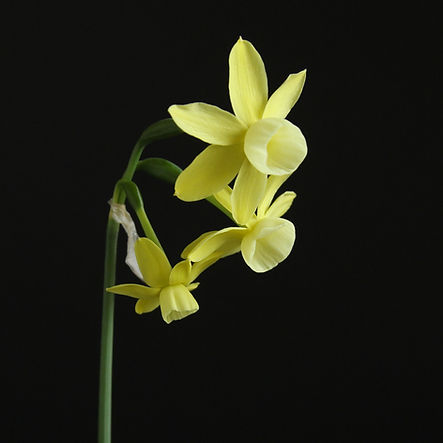
Sister to Little Celine and of the same parentage as Little Jen, this charming x rupidulus cultivar is named for a new family member. Flowering at 15cm high, with 1-3 flowers per stem, the perianth is a stronger acid yellow, and the cup smaller, than her siblings, being a more distinct reverse bicolour. The three together make a delightful trio.

PALEHEART


PALEHEART 2 W-Y/W
Sister to Little Goldheart, Paleheart is similar in shape and stature, but more ethereal in colour. The perianth and outer corona are palest lemon, repeated at the cup’s inside rim which then deepens and becomes brighter towards the deep green eye.

PAULINE ANNE

PAULINE ANNE 2-W-Y
Named for my lovely neighbour Pauline, who is the most skilled and fastest peeler of bulbs prior to chipping. Every year she saves me so much time by doing the fiddliest job for me, leaving me to do the actual chopping up. Her daffodil is a delicate lemon and creamy white bicolour, with the corona expanded and lightly frilled at the mouth. The flowers are held on erect, 12cm stems, with the flowers facing slightly upwards, giving an appealing posture. To add to all this, it has a delightful rich fragrance.

POLAR WIND

POLAR WIND 6 W-W
Bred from Mitzy x Keira hybrid KB-M-1-2007, this is a favourite here for its strongly swept back, sharply pointed perianth. Flowering at 12cm high, it usually opens straight away as a clean white colour, and the long, straight corona is expanded at the mouth into jagged lobes. The whole spiky effect suggested an icy name! I need to bulk this up another year before I can offer any.

RE-ENTRY

RE-ENTRY 7 Y-Y
This selection from N. rupicola never fails to make me smile when it ‘does its thing’ imitating a space capsule re-entering the atmosphere, with the fiery trail flaring back from the point of entry. Although not all flowers will perform in a given year, when they do they are remarkable for the reflexed perianth AND corona, in the species’ brightest yellow and with one of my favourite daffodil perfumes. The precision of the six-lobed corona and delicately mucronate perianth tips is appealing even in the unreflexed form. This is definitely one to watch once the buds start to appear.


REET PETITE


REET PETITE 6 W-Y
Some of you will know our little Sweet Petite, a customer favourite. When I showed a friend its sister, he laughingly said "So that one is Reet Petite?" The name stuck. So here she is, and in the immortal words of Jackie Wilson, “Rrrrr Reet Petite the finest girl you ever want to meet”.
While Sweet Petite is demure and unassuming, Reet Petite is more like a show-girl, with her ample perianth flung back and flamboyantly frilled corona. Shy and retiring she is not!
Perfectly miniature and in proportion (I hesitate to mention vital statistics at this point), she will not be ignored on the showbench. Along with her looks, there is the rich perfume to add to her allure.

TABILLA


TABILLA 2 Y-Y
The latest of our crosses using N. albimarginatus as pollen parent, this time with N. atlanticus as mother. As I’ve come to expect, it has the beautifully overlapping perianth and wonderful scent of N. albimarginatus, but, as yet, only a single flower per stem. The distinctive bulbs are almost oblong and multiply quickly. Excellent show form in an underrepresented division.